Our Operations
Our operations focus on delivering reliable and efficient alpine river water for irrigation, enhancing agricultural productivity and sustainability across more than 45,000 hectares of central Canterbury farmland.
Our water comes from the Rakaia and Waimakariri rivers. Scheme Stages 1 and 2 use run-of-river water from the Rakaia River, backed by stored water released from Lake Coleridge when river flows are low. Our Sheffield scheme takes water from the Waimakariri River and holds it in a storage pond for the drier months. More than 360 kilometres of underground pipeline carries low-nutrient alpine water to our shareholders’ farm gates, irrigating 45,600 hectares of dairy, arable, livestock and mixed farmland.
Our Story.Rakaia River Supply Area: Stage 1.
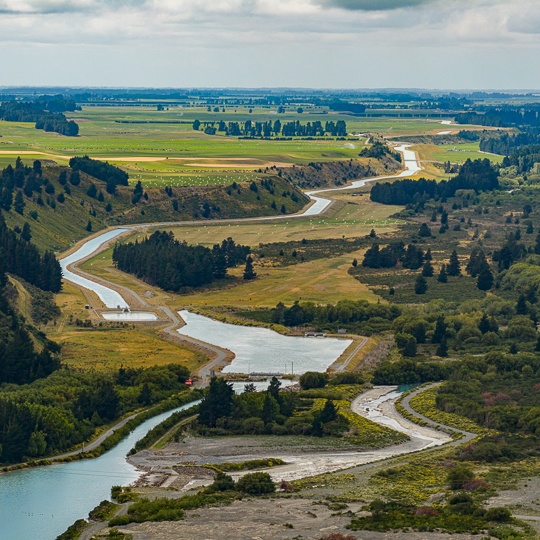
Stage 1 is the first part of our Rakaia River supply area. It sits within the Selwyn district, on the Central Plains between the Southern Alps and the Waimakariri and Rakaia rivers. When it was built, it was one of the largest irrigation projects ever undertaken in the South Island, with $157 million invested in construction and a further $30 million in design and resource consents.
Stage 1 has been operating since 1 September 2015. During the irrigation season it runs 24 hours a day, seven days a week, giving our shareholders a reliable supply of water.
Size
- 23,000 hectares of farmland, bordered by the Hororata and Rakaia rivers
- Up to 180 million cubic metres of low-nutrient alpine water delivered each year
Infrastructure
- A 17-kilometre canal carrying water from the Rakaia River to our piped distribution network
- 130 kilometres of underground pipeline
- 13 bridges
- 12 pump stations
Water intake and delivery
- Our Rakaia River intake is about 8 kilometres downstream of the Rakaia Gorge Bridge.
- Water passes through control structures, sediment retention ponds and a fish screen before entering the main headrace.
- A computerised control system manages the piped network, delivering water to the farm gate at a pressure equivalent to a 40-metre head.
Environmental benefits
- Our scheme gives shareholders the infrastructure to switch from groundwater to low-nutrient alpine water, easing pressure on aquifers and helping restore flows in lowland streams.


Rakaia River Supply Area: Stage 2
Stage 2
Stage 2 extends our Rakaia Stage 1, covering land between the Selwyn and Waimakariri rivers. It was the largest dryland conversion in our scheme. Construction took place in 2017 and 2018, with $182 million invested, and the project was delivered on time and on budget.
Like Stage 1, Stage 2 uses run-of-river water from the Rakaia River, backed by consented stored water from Lake Coleridge. The water is delivered through an entirely underground pipeline network, which supplies pressurised water to the farm gate, so shareholders don’t need to pump water on farm. This saves energy and makes the system more efficient.
Size
- 20,000 hectares of additional farmland irrigated since 2018
Infrastructure
- 199 kilometres of underground pipeline, slightly further than the distance from Christchurch to Kaikōura
- A 23-kilometre section of large-diameter (2.5-metre) glass reinforced plastic (GRP) pipe
- 12 pump stations
- 3 pressure-reducing stations
Water intake and delivery
- Stage 2 draws on the same Rakaia River intake as Stage 1 and continues from the end of the Stage 1 network.
- The piped network delivers pressurised water directly to the farm gate, so no on-farm pumping is needed.
Environmental benefits
- Our scheme gives shareholders the infrastructure to switch from groundwater to low-nutrient alpine water, easing pressure on aquifers and helping restore flows in lowland streams.



Sheffield Scheme
Our Sheffield scheme is physically separate from Stages 1 and 2 and draws its water from the Waimakariri River. It is the smallest part of our scheme, covering about 4,300 hectares, and was built at a cost of $42 million. It began operating in November 2017.
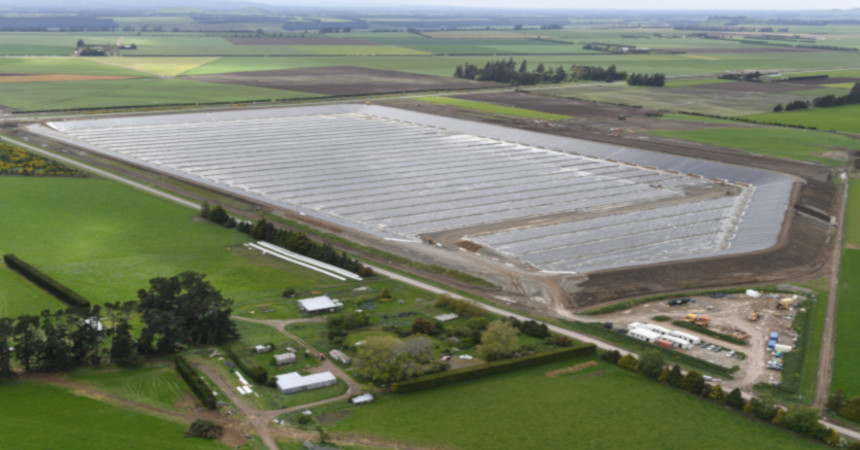
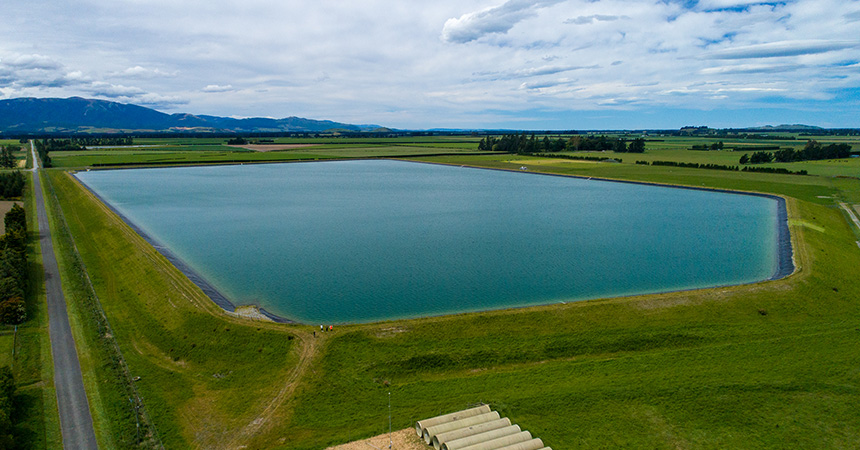
Sheffield’s standout feature is its storage pond. Water is stored when river flows are high, giving shareholders a stable irrigation supply through the dry season. Like the Rakaia River, the Waimakariri River is subject to low-flow restrictions, which limit how much water we can take when the river is low.
Infrastructure
- A 2.5-megawatt pump station
- 37 kilometres of pipeline
- A storage pond holding up to 2.15 million cubic metres of water
Water intake and delivery
- Our intake is on the Waimakariri River, directly opposite the Kowai River.
- Water enters the intake channel and passes through a rock fish screen and into a sediment retention pond.
- The pump station moves up to 2 cubic metres of water per second, lifting it 80 metres vertically into an open supply race.
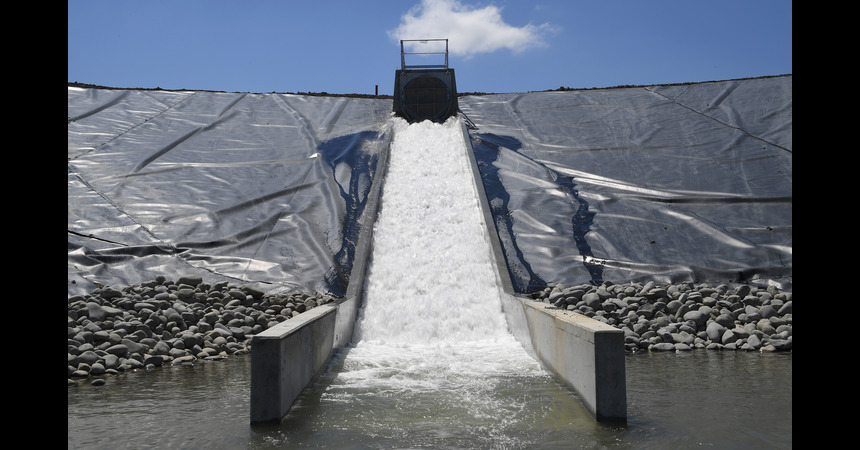
- The water then flows through three concrete drop structures, which slow it down, before entering a 1.6-metre inlet pipe for the final kilometre to the storage pond.
Storage pond
- The pond covers about 40 hectares and holds up to 2.15 million cubic metres of water.
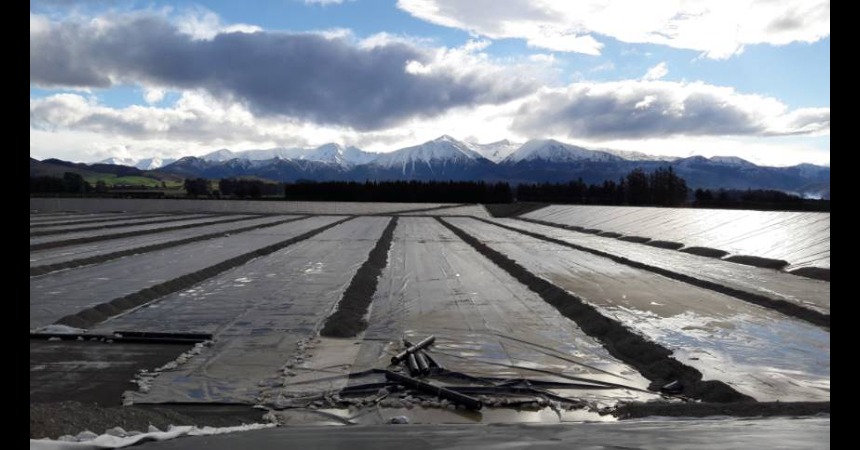
- It is lined with 300,000 square metres of high-density polythene to stop water seeping through the gravel floor.